
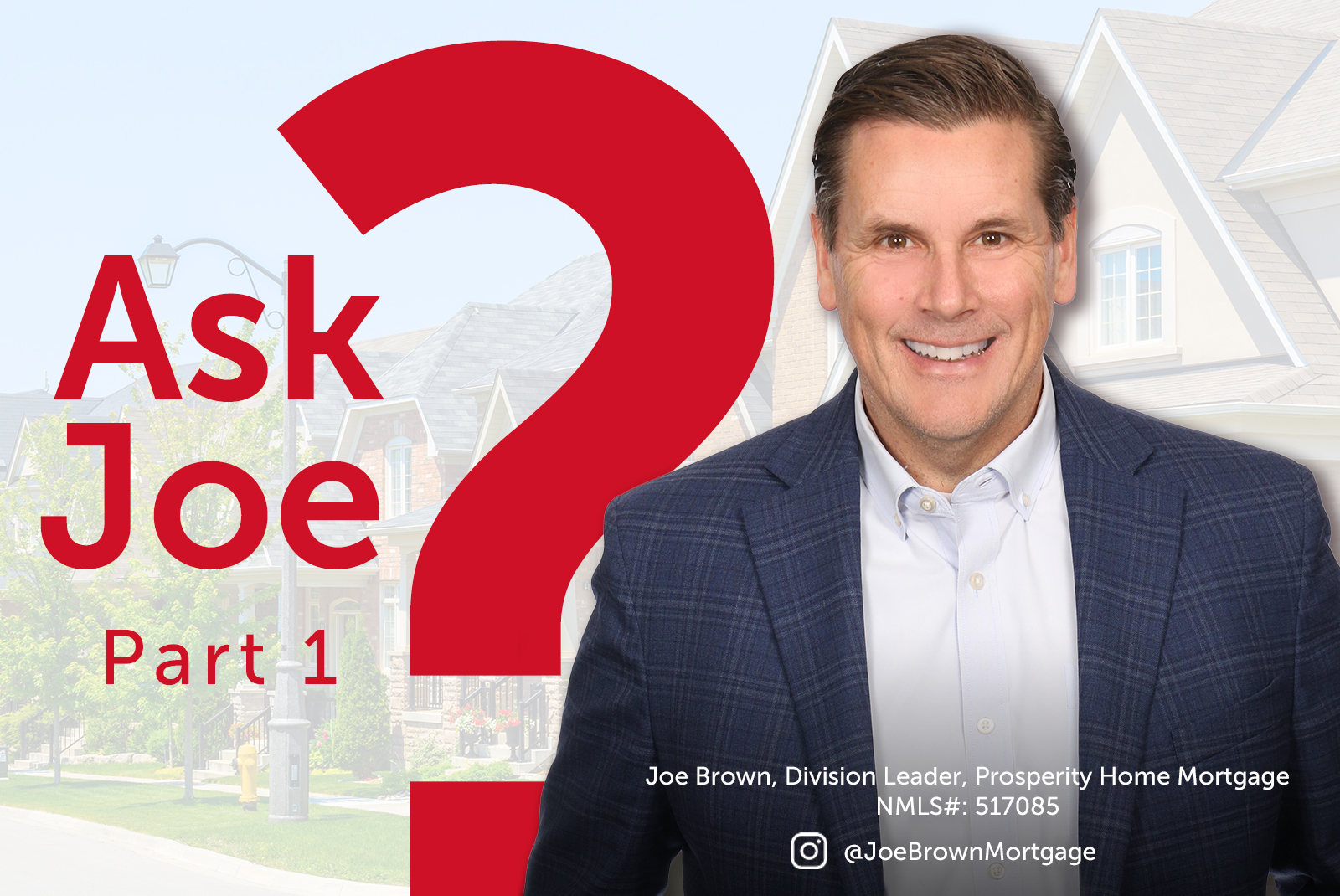
Joe Brown, NMLS #517085, Division Sales Leader, Prosperity Home Mortgage, answers common questions about debt-to-income ratios in this three-part “Ask an expert” series. In part one, Joe talks about what a debt-to-income ratio is and what it’s used for.
Part one: What is a debt-to-income ratio?
Key Insights
- Your debt-to-income ratio is a way to evaluate what mortgage amount you can reasonably pay and is often used by lenders.
- There are two types of debt-to-income ratios: front-end debt-to-income ratio and back-end debt-to-income ratio.
- Lenders use your debt-to-income ratio to determine your loan eligibility; it can impact your loan terms and interest rate, so it’s important to keep it low.
When you start looking at real estate, you're bound to run into a lot of terms and concepts that you’re not familiar with. That’s okay — it’s why we post articles like this to help you feel informed and confident when making real estate decisions. Today, I’d like to explain one such term: debt-to-income ratio. It may sound confusing, but it’s actually a pretty simple concept.
After you’ve applied for a loan, your chosen lender will review many factors to determine your eligibility — if you have a job, your credit score, additional assets you may have, etc. One of the most important factors is your debt-to-income ratio, which evaluates your ability to responsibly repay a mortgage bill each month.
In layman’s terms, your debt-to-income ratio shows how much of your total income will be spent paying off monthly debts. Lenders calculate your debt-to-income ratio and review it to make sure that your housing-related expenses, including your mortgage, won’t take up too much of your total income.
How do lenders use a debt-to-income ratio?
In general, less debt means more buying power. The lower your debt-to-income ratio is, the more money you have to pay back the loan, even if other expenses like car repairs or life events like a new baby pop up. This gives lenders more confidence that they’ll earn back their money. If your debt-to-income ratio is higher, lending to you is more of a risk. This can affect your loan’s terms and interest rate, so it’s important to keep your debt-to-income ratio as low as possible.
The two types of debt-to-income ratios and what they mean for you
There are really two types of debt-to-income ratios: front-end debt-to-income ratio and back-end debt-to-income ratio:
- The front-end ratio (often called the housing ratio), shows what percentage of your gross monthly income would go toward principal, interest, taxes and insurance (PITI).
- The back-end ratio shows the percentage of your gross monthly income needed to cover your housing (PITI) and other monthly debt obligations like credit cards, car loans, student loans and child support.
Both are important metrics, but a back-end debt-to-income ratio provides a more comprehensive view of your financial state and is often used by lenders to gain a “complete picture” of your debts and income.
However, a front-end debt-to-income ratio can be a good tool for potential buyers to gauge how much of their monthly income will go toward a specific property and help them narrow down what their budget should be when looking at homes. If you’re considering buying, it’s a good idea to work with your lender to get prequalified or preapproved for a loan.
Now that you understand what a debt-to-income ratio is and how it’s used, I hope you’ll join me for part two and part three of the series, where I give a comprehensive explanation on how to calculate your debt-to-income ratio.
If you have any questions, please feel free to reach out to us at Edina Realty or contact your Edina Realty agent–we’re all happy to help!
Prosperity Home Mortgage is an affiliate of Edina Realty. See Affiliated Business Arrangement Disclosure Statement
Prosperity Home Mortgage, LLC®, Prosperity Home Mortgage® and the Open Door Icon are Registered in U.S. Patent and Trademark Office.
Prosperity Home Mortgage, LLC is not affiliated with or endorsed by any government agencies. Some and/or all qualifying criteria may be set by independent third-party program sponsors. Not all borrowers will qualify. Contact your mortgage consultant for program eligibility and details.









 ©2026 Prosperity Home Mortgage LLC®. (877) 275-1762. 3060 Williams Drive, Suite 600, Fairfax, VA 22031. All first mortgage products are provided by Prosperity Home Mortgage, LLC®. Not all mortgage products may be available in all areas. Not all borrowers will qualify. NMLS ID #75164 (For licensing information go to: NMLS Consumer Access at