
Key insights
- After several slower years, home sales are expected to increase in 2026 as more buyers and sellers re-enter the market.
- Inventory is improving in many areas, but most markets in Minnesota and western Wisconsin are still not truly balanced and tilt in favor of sellers.
- Mortgage interest rates are projected to hover at around or slightly below 6% by the end of 2026.
- Home prices will likely see modest, steady growth (low- to mid-single digits).
- The “lock-in effect” should slowly ease as life changes and slightly lower rates motivate more homeowners to list, creating new opportunities on both the buy and sell sides.
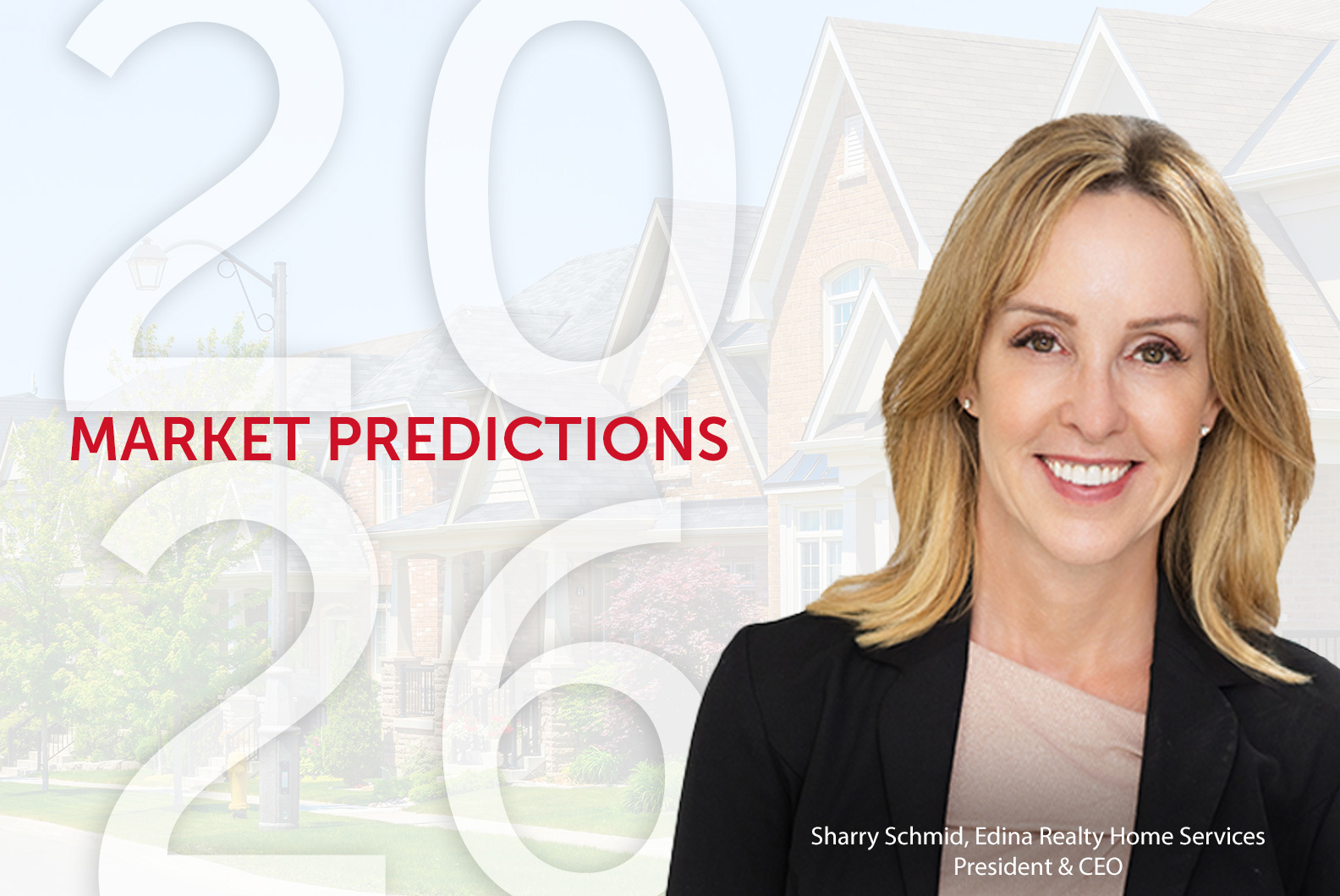
Sharry Schmid, president & CEO, Edina Realty Home Services
As president & CEO of Edina Realty Home Services, Sharry Schmid leads the top brokerage in the market and guides over 2,000 REALTORS® throughout Minnesota, western Wisconsin and southwestern Florida.
One question I hear frequently is: “Will 2026 finally be a better time to move?”
Behind that are a lot of personal questions:
- Can I afford to buy my first home if rates are still around 6%?
- Is it worth giving up my 3% mortgage if I need more space or want to downsize?
- Will I have more choices, or will I still be competing with multiple offers?
My answer, as always, is that it depends on your goals and your situation – but 2026 is expected to offer more opportunities than we’ve seen in recent years.
Let’s take a look at what we’ve just lived through and then look ahead to 2026.
Looking back at 2025
In 2025, the housing market continued to recalibrate after the extremes of the pandemic era and ultra-low interest rates. We saw a mix of challenges and progress, and real estate continued to be, as always, hyper-local and segmented by location and price point.
Minnesota*
- The inventory (supply) of homes for sale increased 1.7% over 2024, but still did not keep pace with buyer demand.
- Prices rose slightly, with median sales prices up 0.9% to $351,000.
- Closed sales activity was up 2.2% over Oct. 2024.
- Average days on market increased 7.1% to 45 days.
- Months supply remained flat at 3.1 months, remaining a seller’s market.
According to US Census data, Minnesota has the highest homeownership rate in the nation (50.80%) for people under 35, and an impressive 71% of households own their homes, which bodes well for wealth building and community stability.
Wisconsin**
- The inventory (supply) of homes for sale did not keep pace with buyer demand, but it did increase 1.7% over 2024.
- Prices rose, with median sales prices up 6.9% to $331,500.
- YTD home sales were up 3.4% over 2024.
- Average days on market increased 4.4% to 71 days.
- Months supply decreased 2.5% to 3.9 months, remaining a seller’s market.
What will happen in real estate in 2026?
No one has a crystal ball to predict the future, but economists and housing experts are more aligned about 2026 than they’ve been in a while, agreeing that it will likely be a year of increased opportunities.
- The National Association of REALTORS forecasts that existing home sales could rise as much as 14% as mortgage rates ease and pent-up demand is released.
- Fannie Mae’s Economic and Strategic Research Group is slightly less bullish with a forecasted 7.3% increase in sales.
Housing is highly dependent on jobs and interest rates.
- Minnesota’s economy is strong with an unemployment rate of 4.1% (Sept. 2025).
- Wisconsin also has a low unemployment rate at 3.7% (Sept. 2025).
- Many predict that interest rates will hover around 6% for a 30-year fixed-rate conventional loan.
A seller’s market that is slowly moving toward balance
Most of Minnesota and western Wisconsin will likely remain seller-leaning in 2026, but not at the frenzied levels we saw a few years ago.
- Inventory has been ticking up, with more homes for sale than a year ago in both states.
- Months’ supply is gradually growing, but in many areas, it still falls short of the four- to five-month benchmark that signals a balanced market.
For sellers, that means:
- Well-priced, well-prepared homes should still sell – often quickly – especially in popular neighborhoods and price ranges
- Multiple offer scenarios may be less common
- The time a home spends on the market before sale may increase slightly
- Strong equity will continue to offer opportunities to move
For buyers, that means:
- Slightly more inventory and a bit more time to make decisions.
- Competitive offers that include home inspections and fewer contingencies
Mortgage interest rates are easing
After reaching nearly 7% in recent years, average 30-year mortgage rates have been trending down toward the low-6% range heading into 2026.
As I mentioned earlier, forecasters like Fannie Mae are predicting:
- Average 30-year fixed rates will be around 6.2% in early 2026
- The possibility of 5.9% by the end of 2026
Lower rates offer greater purchasing power and give buyers the ability to start building equity and personal wealth. And when you also factor in shelter and the ability to make home improvements without a landlord’s permission, the benefits go well beyond just financial ones.
It’s important to understand that the low rates of recent years (3-4%) were the exception if you look at historical trends. Remember, even when you buy at a higher rate, there are financing opportunities, including the option to buy down interest rate points or to refinance in the future. Talking to a mortgage consultant can help determine what might be right for you.***
The lock-in effect loosens its grip
For several years, homeowners with a ~3% interest rate have been reluctant to move because their next loan would come at a higher rate. As we’ve moved further away from the pandemic era, the lock-in effect has softened.
- Life events — what we often refer to as the “Ds” (degrees, diamonds, diapers, divorces, downsizing and deaths) — will continue to drive moves, regardless of rates.
- As time passes and more people buy or refinance at higher rates, a growing share of homeowners will no longer be locked into ultra-low mortgages. In fact, according to data from Fannie Mae Mortgage Database, about 20.4% of current mortgage holders still have a sub-3% rate, while 19.7% have a 6%+ rate. This gap continues to close as more and more sellers and buyers enter the market.
- With rates easing slightly, the payment difference between “staying put” and “moving up or down” will narrow for some owners, making a move more feasible.
The result? We’re likely to see more new listings in 2026 than in recent years, which should help create additional opportunities for buyers while still supporting solid prices for sellers.
Moving forward: Your 2026 outlook
Ultimately, whether 2026 is the “right time” to buy or sell depends less on headlines and more on your goals, your finances and what you need from your home in the next stage of your life.
What I can say with confidence is this:
- The market is healthier and more balanced than it has been in several years, even if we’re not fully back to “normal.”
- We expect more opportunities for both buyers and sellers as inventory improves and rates ease slightly.
- Real estate remains a powerful long-term tool for building wealth and stability.
- Real estate is local, and getting the advice of a professional is always in your best interest.
Edina Realty agents have the deepest local network across Minnesota, western Wisconsin and southwest Florida. They know the subtleties of each neighborhood, understand current pricing and inventory, and have access to homes that may not yet be on the open market.
If you’re wondering whether 2026 is your year to make a move, reach out to your Edina Realty agent or connect with one in your area today.
*Based on October 2025 data from the multiple listing services for the state of Minnesota, published by the Minnesota Association of Realtors. All percentages are year-over-year.
**Based on the October 2025 Wisconsin Real Estate Report published by the Wisconsin REALTORS Association. All percentages are year-over-year unless otherwise noted.
***Prosperity Home Mortgage, LLC does not offer financial advice. This information is provided for informational purposes only and does not constitute legal, tax, or financial advice. Not all borrowers will qualify.
Prosperity Home Mortgage Edina Realty Insurance is an affiliate of Edina Realty. See Affiliated Business Arrangement Disclosure Statement








 ©2026 Prosperity Home Mortgage LLC®. (877) 275-1762. 3060 Williams Drive, Suite 600, Fairfax, VA 22031. All first mortgage products are provided by Prosperity Home Mortgage, LLC®. Not all mortgage products may be available in all areas. Not all borrowers will qualify. NMLS ID #75164 (For licensing information go to: NMLS Consumer Access at